
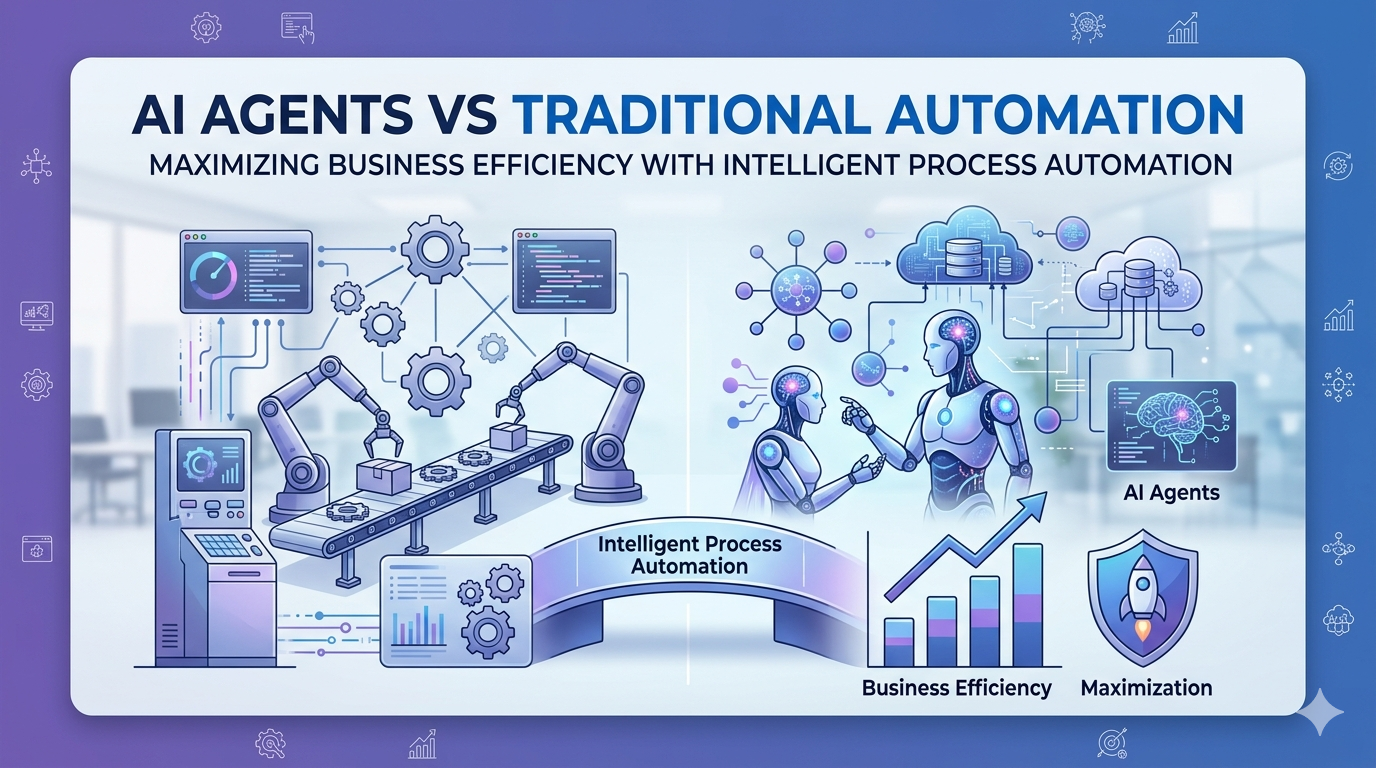
In the age of rapid digital transformation with AI agents, businesses are rapidly outgrowing conventional solutions. Traditional automation, while effective in static scenarios, often lacks the adaptability modern organizations demand. AI agents, powered by advanced machine learning, present a paradigm shift—reshaping business process automation with AI to be more dynamic, intelligent, and context-aware.
AI Agents vs Traditional Automation: Understanding the Landscape
Traditional automation is rooted in rule-based scripting, handling repetitive tasks that require minimal human judgment. While useful for standard workflows, these systems struggle when exceptional events or ambiguous data arise.
By contrast, AI agents can perceive their environment, learn autonomously, and make complex decisions. This capability allows businesses to automate not just basic, but also nuanced or evolving processes, unlocking efficiencies previously out of reach.
“AI agents redefine automation by enabling contextual reasoning and on-the-fly adaptation, critical for modern digital enterprises.”
Core Differences
- Traditional Automation: Rigid, rule-based, limited to structured data and predefined paths.
- AI Agents: Flexible, adaptive, capable of handling unstructured data, learning from real-world interactions.
Understanding where each excels is pivotal for leveraging automation technologies strategically.
Leveraging AI Agents Integration Services for Core Business Functions
AI agents integration services are central to embedding advanced automation into legacy systems and modern architectures alike. Core business functions such as customer service, supply chain management, and financial operations all benefit from this integration.
- Customer Service: AI agents deliver contextual answers, sentiment analysis, and intent recognition, outpacing scripted chatbots.
- Operations: Automate procurement, invoicing, and compliance checks with intelligent workflows.
- IT & Security: Proactive threat detection and autonomous system recoveries minimize downtime and losses.
Integrating these AI-powered capabilities unlocks intelligent process automation (IPA), where machines can autonomously resolve routine—yet critical—decisions with accuracy and speed.
Digital Transformation with AI Agents: Where They Outperform
Successful AI deployment isn’t just about replacing manual labor—it’s about fundamentally enhancing business models. Digital transformation with AI agents facilitates:
- Real-time process optimization
- Automated anomaly detection
- Self-serve analytics and insights
- Improved compliance and audit trails
By deploying AI agents, companies gain a digital workforce capable of handling both mundane tasks and those requiring higher-order reasoning.
Key Areas of Business Process Automation with AI
To realize large-scale value, organizations should prioritize automating high-impact areas. Among these:
- Document Management: AI agents extract, classify, and route documents with NLP and OCR technologies.
- Customer Interactions: From voice assistants to advanced chat, agents maintain seamless engagement 24/7.
- Supply Chain Automation: Dynamic demand forecasting, adaptive inventory management, and predictive logistics.
- Finance and Compliance: Intelligent agents monitor for fraud, automate reconciliations, and ensure regulatory adherence.
Business process automation with AI breaks down traditional silos, creating cross-departmental efficiencies.
AI Workflow Automation Tools Comparison
Choosing the right platform is vital. Below are popular options compared for enterprise suitability:
| Platform | Core Strengths | Ideal Use Case |
|---|---|---|
| UiPath AI Center | Seamless RPA+AI, OCR, NLP | Enterprise IPA |
| Microsoft Power Automate | Deep integration with MS ecosystem | Office productivity |
| IBM Watson Orchestrate | Context-aware automation, NLP | Complex documents |
| Google Cloud AutoML | Vision, language ML APIs | Data-rich workflows |
| OpenAI GPT Agents | Conversational, reasoning capabilities | Knowledge work |
Evaluating AI workflow automation tools comparison will help align features with business requirements and scalability goals.
Best AI Agent Platforms for Business
The market is quickly maturing, but the best AI agent platforms for business share core attributes:
- Scalable architecture
- Integration APIs for legacy and cloud systems
- Prebuilt models for rapid deployment
- Strong data privacy and compliance frameworks
Leading platforms include Microsoft Azure AI, Google Vertex AI, and custom solutions built with open-source frameworks like LangChain and Rasa. The choice depends on:
- Industry-specific needs
- Data residency requirements
- Team expertise with ML and automation tools
The Future: From Intelligent Process Automation to Autonomous Operations
As AI agent integration becomes seamless, businesses transition from basic intelligent process automation to increasingly autonomous operations. Key next steps include:
- Prioritizing change management and process reengineering
- Upskilling teams to co-work with AI agents
- Establishing robust monitoring for AI decision-making
Those who harness the synergy of AI agents vs traditional automation will stay ahead in operational excellence and innovation, making AI agents a cornerstone of future-ready enterprises.