
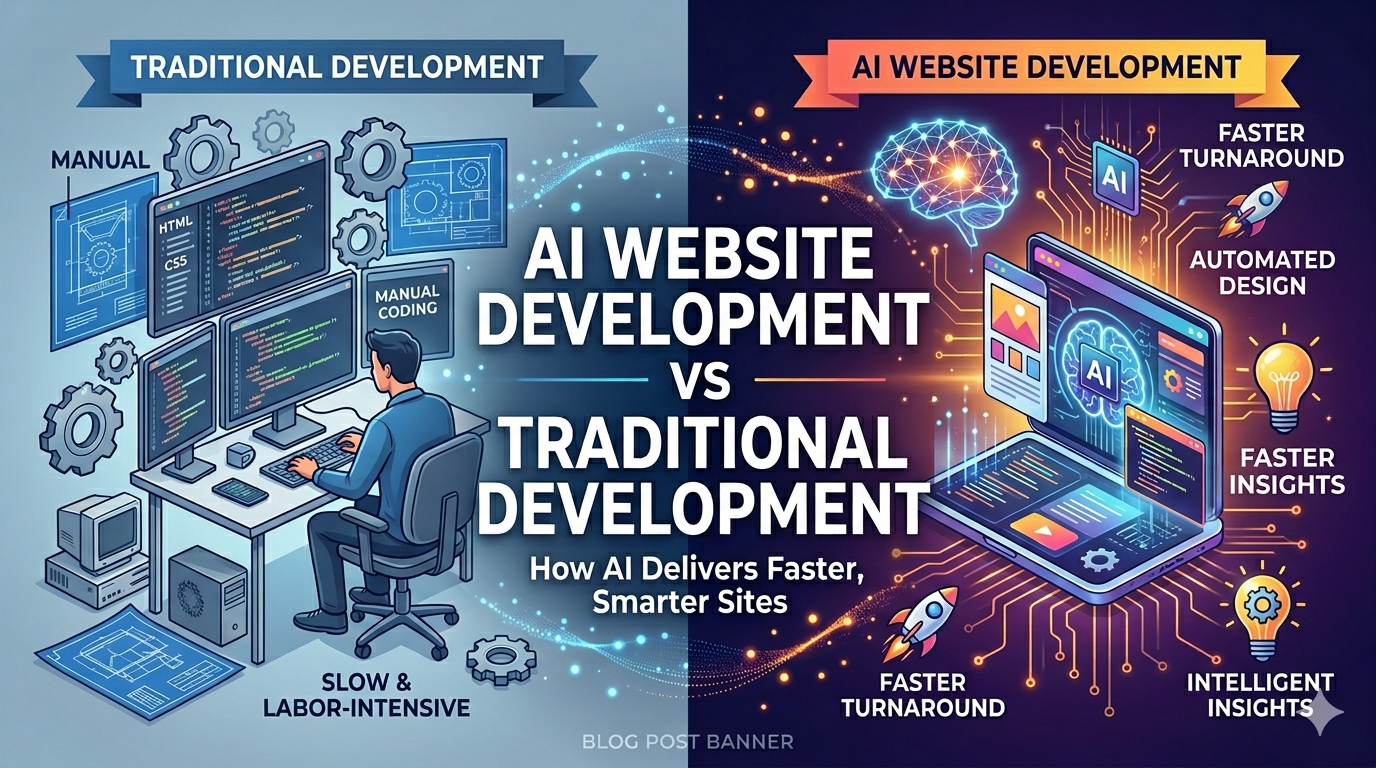
The landscape of website development is undergoing a seismic shift as artificial intelligence revolutionizes how professionals build, launch, and maintain digital experiences. Traditionally, web development required extensive manual coding, iterative design cycles, and weeks—sometimes months—of development time. Now, with the advent of AI-driven web development services, agencies and businesses can launch robust, visually impressive, and highly performant sites at an unprecedented pace.
AI Website Development vs Traditional Development
When comparing AI website development vs traditional development, the distinctions extend beyond mere speed. While traditional workflows depend on the expertise of designers and developers working through detailed sprints, AI automates many core steps, resulting in:
- Rapid wireframing and prototyping
- Auto-generated content and layouts
- Smart asset management (images, icons, media)
- On-the-fly code generation and optimization
This efficiency not only accelerates the time-to-market but also reduces human error and lowers the barrier for iterative improvements.
How AI Automates Web Development Tasks
Modern AI algorithms are capable of handling a multitude of web development tasks autonomously:
- Layout and Design Generation: Trained on thousands of successful web templates, AI can propose layout suggestions or auto-generate page sections tailored to brand guidelines.
- Content Personalization: Advanced NLP models power dynamic web copy and personalized user journeys.
- Code Optimization and Bug Fixing: AI tools scan and refactor code for better maintainability, performance, and security.
- Testing and Quality Assurance: Automated test scripts powered by AI catch UI issues and logic errors early in the process.
"AI is not just an assistant but a creative and analytic partner, minimizing tedious tasks so developers can focus on high-value, user-centric features."
AI-Powered Website Builders Comparison
Engineers looking to streamline web projects should carefully assess leading AI-powered website builders. Key criteria include:
- Ease of AI integration for website development
- Flexibility versus template rigidity
- Support for custom code and 3rd-party APIs
- Built-in website speed optimization using AI
- Quality of AI-generated content, imagery, and accessibility features
- Collaboration tools for team-based development
Popular options include Wix ADI, Framer AI, and 10Web, each leveraging AI-generated websites benefits such as instant adaptation for mobile, image palette selection, and even SEO recommendations out-of-the-box.
How to Use AI for Faster Web Development
Transitioning to an AI-first workflow doesn't mean abandoning all manual processes but rather leveraging AI strategically for:
- Instant generation of HTML/CSS based on simple prompts
- Automated population of demo content and images
- Adaptive layout suggestions during client feedback loops
- One-click deployment and staging environments by AI orchestration
Best practices include:
- Starting with clear business goals and letting AI generate multiple variants for A/B testing.
- Integrating AI for asset optimization (image compression, code minification).
- Setting up continuous integration pipelines that leverage AI for visual regression testing.
Website Speed Optimization Using AI
AI isn't just fast in building sites; it's also key to achieving optimal web performance. AI-driven tools dynamically optimize:
- Image formats and loading strategies (WebP, lazy-loading)
- Asset bundling and tree-shaking for JS/CSS
- Personalized caching policies
- Real-time identifying and repairing of slow-loading UI elements
AI-Generated Websites Benefits: Beyond Speed
While project velocity is a headline advantage, AI-generated websites benefits extend to:
- Improved accessibility compliance (AI-powered screen reader adjustments)
- Better adaptation to global markets through AI-driven localization
- Continuous improvement via user interaction analysis and adaptive UI suggestions
- Lower cost by minimizing man-hours on repetitive tasks
AI Integration for Website Development: The Path Forward
To maximize the advantages of AI, organizations should embrace AI integration for website development at multiple touchpoints. This means not only using AI-powered tools but also deeply embedding machine learning models into CI/CD workflows, user testing, analytics, and ongoing website maintenance.
Hire AI Web Development Agency: When to Seek Expert Help
Adopting new AI-driven tools often requires a level of technical fluency and strategic planning. That's where choosing to hire an AI web development agency makes sense:
- Need for custom AI model integration beyond out-of-the-box tools
- Ambitious project scope requiring both machine learning and traditional full-stack skills
- Ensuring project security, scalability, and future-proofing via enterprise-grade solutions
Conclusion
AI website development vs traditional development isn't just a contest of speed—it's a transformative leap in workflow productivity, creative capabilities, and ongoing optimization. By leveraging the right combination of AI-powered website builders, custom integrations, and professional guidance, engineering teams can deliver web projects faster and smarter than ever. As the field evolves, expect AI-driven web development services to unlock even more advanced automation, analytics, and user-centric design features, pushing the boundaries of what’s possible in digital product delivery.